
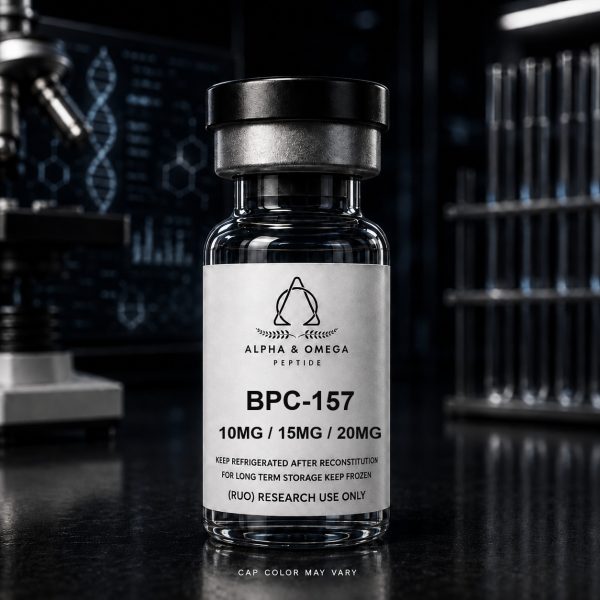
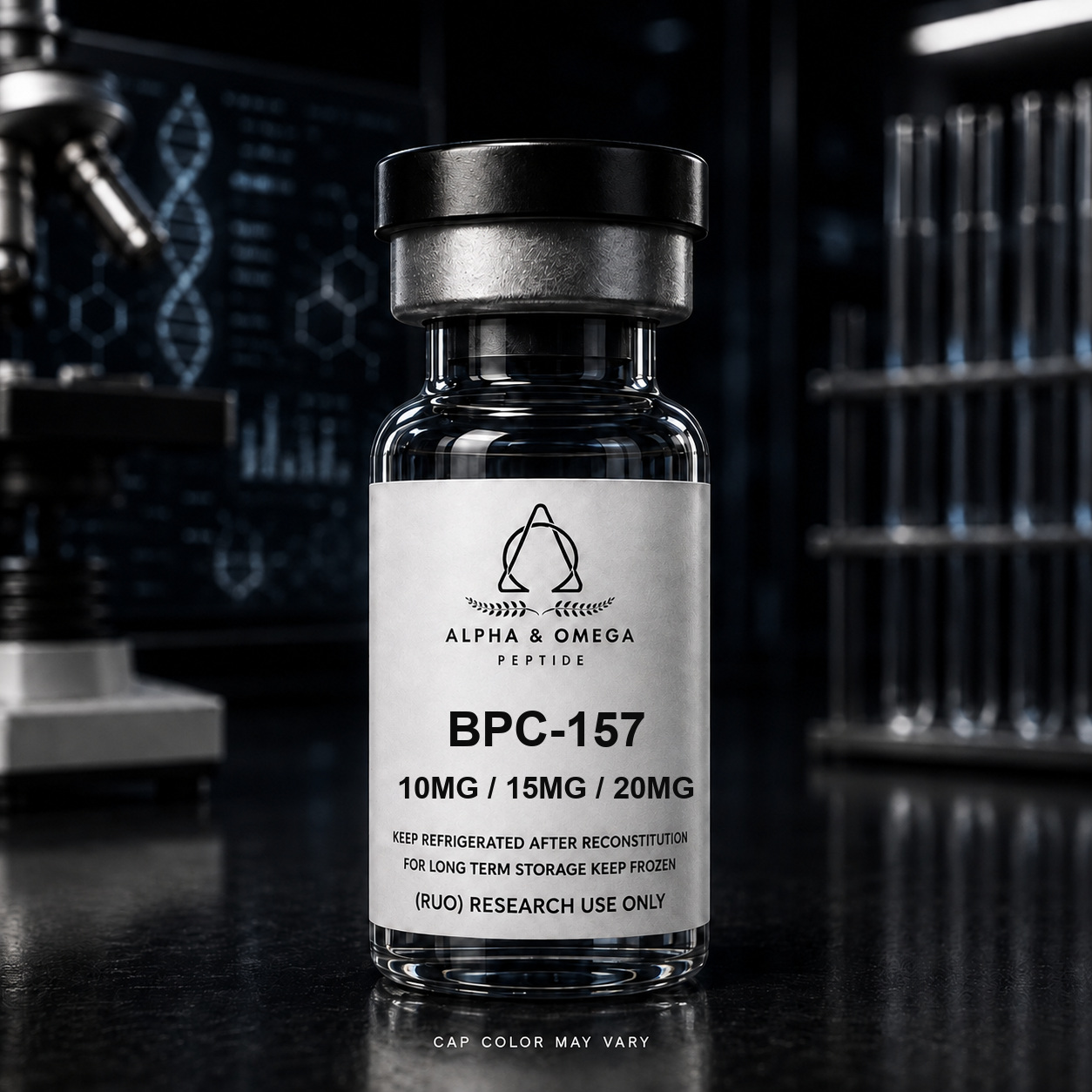
BPC-157

Price range: 45.00£ through 65.00£
BPC-157 is a synthetic 15-amino-acid peptide discussed in preclinical scientific research. Explore its research background, published literature and current evidence limitations. BPC-157 is not an established MHRA-licensed treatment in the UK, and no therapeutic benefits or human-use recommendations are claimed.
BPC-157: Scientific Background, Research Literature and Evidence
BPC-157, also written as BPC 157, is a synthetic peptide that has been investigated in preclinical scientific research. It is commonly described in the scientific literature as a pentadecapeptide, meaning a peptide consisting of 15 amino acids. Over the years, researchers have examined its molecular characteristics, biological activity and possible relevance to several areas of experimental biology. However, the distinction between laboratory research and established medical evidence is essential when interpreting information about this compound.
This page provides an educational overview of BPC-157, including its scientific background, peptide structure, preclinical research, human evidence, safety uncertainties and regulatory considerations. It also explains why findings from laboratory experiments and animal models cannot automatically be applied to people. The purpose is to help readers understand the published research without presenting experimental observations as proven medical outcomes.
The term BPC 157 peptide is frequently used in online discussions and scientific searches. Search phrases such as BPC 157, BPC 157 benefits and BPC 157 for sale may appear in general online searches, but their popularity does not establish clinical effectiveness, safety, authorisation or suitability for human use. Scientific interpretation should always be based on the quality of the evidence rather than the frequency of a particular search term.
1. What Is BPC-157?
BPC-157 is a laboratory-produced peptide studied in experimental research. A peptide is a molecule made from amino acids connected by chemical bonds. Amino acids are fundamental building blocks involved in the structure and function of proteins and many biological processes. Peptides can vary considerably in length, structure and biological activity. A short peptide and a much larger protein are not necessarily interchangeable, even when they contain some of the same amino acids.
BPC-157 is generally identified as a sequence of 15 amino acids. Its name is associated with the phrase Body Protection Compound, while the number 157 identifies the particular compound discussed in the literature. It is important not to interpret the name as proof that the substance protects the human body or has an established protective medical effect. A compound’s name is not a substitute for controlled evidence.
Scientific publications have discussed BPC-157 in connection with experimental investigations of cellular signalling, tissue biology and other physiological processes. Much of the earlier literature concerns animal models and laboratory experiments. These studies can help researchers develop hypotheses and identify questions for further investigation, but they do not independently demonstrate that a substance is an effective or safe treatment for a human condition.
2. Understanding Peptides and Their Scientific Study
Peptides are studied across biochemistry, molecular biology, pharmacology and pharmaceutical science. Their properties depend on several factors, including amino-acid sequence, molecular structure, stability, solubility and interactions with biological environments. Small changes in a peptide’s structure can influence how it behaves under experimental conditions.
Researchers studying a synthetic peptide may investigate its chemical identity, purity, stability, degradation, interactions with cells and behaviour in biological models. These investigations are separate from the question of whether the compound can be developed into an authorised medicine. Pharmaceutical development requires a much wider evidence base, including appropriate manufacturing controls, validated analytical methods, toxicological assessment, pharmacokinetic studies and carefully designed clinical trials.
For BPC-157, these distinctions are particularly important because public discussion sometimes combines experimental findings, proposed mechanisms and claims about human outcomes. A laboratory observation may provide a reason to conduct further research, but it cannot establish a clinical recommendation. Similarly, a result in an animal model cannot establish an appropriate human dose, administration method or long-term safety profile.
3. BPC-157 and Preclinical Research
Preclinical research refers to investigations conducted before a substance has been adequately evaluated in human clinical trials. It can include laboratory experiments using cells, biochemical systems and animal models. Researchers use these methods to examine biological activity, explore possible mechanisms and identify questions that may warrant additional investigation.
Published BPC-157 research includes a range of animal experiments. A systematic review published in 2025 examined the available literature from an orthopaedic and sports-medicine perspective. It identified 36 studies published between 1993 and 2024, comprising 35 preclinical studies and one clinical study. The review described experimental investigations involving muscle, tendon, ligament and bone models, while also highlighting the limitations of the available human evidence.
These findings should be understood within the context of the research methods used. Animal experiments are not equivalent to human clinical trials. Species differ in physiology, metabolism, immune responses, tissue structure and many other characteristics. Experimental conditions may also be tightly controlled in ways that do not reflect ordinary human healthcare settings.
Consequently, an observed effect in an animal model should be described as an experimental finding rather than proof of a benefit in people. Further investigation is necessary before researchers can determine whether a preclinical observation is reproducible, clinically relevant or sufficiently safe to justify human testing.
4. Areas Investigated in Published Literature
Researchers have examined BPC-157 in several experimental settings. These investigations are part of an evolving scientific literature, and they should not be interpreted as evidence that the peptide is an approved treatment for any of the conditions or biological processes discussed.
4.1 Experimental tissue models
Some preclinical studies have examined biological responses in experimental models involving different types of tissue. These studies may measure structural changes, biochemical markers, cellular activity or other laboratory endpoints. Such measurements can provide information about a particular experimental model, but they do not automatically demonstrate meaningful improvements in human health.
4.2 Cellular signalling
Cellular signalling describes the processes through which cells receive, interpret and respond to information. Signalling pathways can influence cell growth, survival, movement, differentiation and interactions with surrounding tissues. Some BPC-157 publications have explored pathways associated with cellular responses. Proposed mechanisms remain subjects for scientific investigation and should not be presented as established explanations of a clinical effect.
4.3 Inflammatory processes
Inflammation is a complex biological response involving immune cells, chemical messengers and interactions between different tissues. Experimental research may measure inflammatory markers or examine how a compound behaves in a model involving an inflammatory response. Changes in an experimental marker do not necessarily predict a beneficial clinical outcome. Human inflammatory conditions differ substantially in their causes, duration, severity and response to treatment.
4.4 Vascular and cellular processes
Some preclinical literature has examined processes associated with blood-vessel formation and cellular activity. These are complex areas of biology involving many interacting signals. A result in a laboratory or animal model cannot establish that the same process will occur in people, nor can it determine whether a change would be beneficial, neutral or harmful in a particular clinical situation.
5. What Does the Human Research Show?
Human evidence is especially important when evaluating a substance that is discussed in connection with health. Laboratory and animal findings can support further investigation, but only appropriately designed human research can begin to establish whether a substance has a particular effect in people. Reliable clinical evidence also needs to address the size and relevance of any observed effect, possible harms, differences between participants and the limitations of the research design.
Human research on BPC-157 remains limited. A systematic review published in October 2026 examined the available human evidence for orthopaedic and regenerative applications. It identified three studies involving a total of 30 participants. The studies included a retrospective investigation involving knee pain, a retrospective pilot study involving interstitial cystitis and a small prospective pilot study examining intravenous safety.
The authors assessed the studies as having poor methodological quality. They identified serious limitations involving risk of bias, indirectness and imprecision, and rated the overall certainty of evidence as very low. The review concluded that BPC-157 should not be used clinically in humans outside ethically approved, regulated and high-quality clinical trials.
This assessment illustrates why the existence of human studies should not be confused with established clinical evidence. A small study may provide preliminary information, but it cannot necessarily determine whether an observed outcome was caused by the compound. Without suitable comparison groups, adequate participant numbers and reliable outcome measurements, it can be difficult to distinguish a genuine effect from other explanations.
Human evidence must also be interpreted according to the specific research question. A small investigation involving one medical condition or administration route cannot establish effectiveness for a different condition or route. Findings from a limited pilot study should not be generalised to unrelated populations or used to create treatment recommendations.
6. Understanding the Difference Between Research and Clinical Evidence
When reading about BPC-157, it is useful to understand the different levels of scientific evidence. Preclinical studies, observational studies, pilot studies and randomised controlled trials each answer different questions and have different limitations.
6.1 Laboratory studies
Laboratory studies may examine a compound under controlled conditions using cells, tissues or biochemical systems. They can help researchers investigate molecular interactions and develop hypotheses. However, laboratory environments cannot reproduce the full complexity of a living human body.
6.2 Animal studies
Animal studies allow researchers to investigate biological responses in a living organism. They may provide information about experimental activity and help identify questions for later research. However, differences between species mean that animal findings cannot independently establish human safety, effectiveness or appropriate clinical use.
6.3 Observational and retrospective studies
Observational studies examine information about participants without necessarily assigning an intervention through a controlled experimental process. Retrospective studies examine information collected from past events or records. These methods can be useful, but they may be affected by selection bias, incomplete records, differences between participants and other factors that make it difficult to establish cause and effect.
6.4 Randomised controlled trials
A well-designed randomised controlled trial generally provides stronger evidence for evaluating an intervention. Participants are assigned to comparison groups using a random process, helping reduce certain forms of bias. Trials also require appropriate outcome measurements, sufficient participant numbers, ethical oversight and transparent reporting. Even a controlled trial must be assessed carefully, especially when examining long-term outcomes and uncommon adverse events.
For BPC-157, the limited quality and quantity of human research mean that important clinical questions remain unanswered. Readers should therefore be cautious when encountering statements that describe experimental findings as established human benefits.
7. Safety and the Limits of Current Knowledge
Safety is a separate question from whether a substance demonstrates biological activity in an experiment. A compound can produce a measurable laboratory effect without having an adequately established safety profile in people. Assessing safety requires systematic investigation of possible adverse effects, interactions, exposure levels, formulation characteristics and the consequences of repeated or prolonged exposure.
For BPC-157, the available human safety information is limited. Small pilot studies cannot reliably identify uncommon adverse events or determine the consequences of long-term exposure. The absence of a reported adverse event in a small study should not be interpreted as proof that no risk exists.
There are also questions about product quality and consistency. Peptide-related products may require appropriate analytical characterisation to establish identity, purity, concentration and stability. Depending on the manufacturing and handling process, additional concerns can include impurities, degradation products, contamination and differences between batches. A label or product description alone cannot establish that a material meets pharmaceutical standards.
Other important research questions include the way a compound is absorbed, distributed, metabolised and eliminated, how its properties change in different formulations, and whether repeated exposure produces effects that have not been identified in short studies. These questions require appropriate scientific and regulatory assessment.
This page does not provide dosing information, administration instructions or recommendations for human use. It is not possible to establish a safe or appropriate personal-use protocol from the limited evidence currently available. Anyone with questions about a medical condition or a substance they may have encountered should seek advice from a suitably qualified healthcare professional.
8. Pharmaceutical Quality and Analytical Characterisation
Pharmaceutical quality is an important part of research into any synthetic peptide. The identity of a compound, its chemical purity, its concentration and its stability are distinct characteristics. They need to be evaluated using appropriate analytical methods rather than inferred from appearance, packaging or a supplier’s general description.
Analytical characterisation can involve methods designed to examine molecular identity, peptide-related impurities, degradation products and other material attributes. Different tests answer different questions. A single analytical result does not necessarily establish every aspect of a material’s quality, and a research report should explain which methods were used and what they can demonstrate.
Manufacturing controls also matter. The consistency of a material can depend on raw-material quality, production conditions, purification processes, packaging, storage and handling. A product’s research description should not be treated as independent proof of pharmaceutical-grade manufacture, sterility or suitability for administration.
These considerations are relevant to the broader scientific discussion of BPC-157 because conclusions from one research preparation may not automatically apply to a different preparation. Differences in identity, purity, concentration or formulation may affect the relevance of comparisons between studies.
9. Regulatory Status and UK Considerations
Regulatory status is an essential part of understanding any substance discussed in a medical or pharmaceutical context. A substance being described in scientific literature, appearing in an online catalogue or being discussed in public forums does not mean that it has been authorised as a medicine.
The UK Medicines and Healthcare products Regulatory Agency (MHRA) provides guidance on the advertising of medicines. Its guidance explains that medicines which are not licensed by the MHRA cannot be advertised, and that promotional information on a company website can fall within the definition of advertising. The guidance also distinguishes factual informative material from promotional claims.
For this reason, information about BPC-157 should not imply that it is an MHRA-authorised treatment, that it is approved for a particular medical condition or that it has established clinical benefits. The regulatory position should always be checked against current official guidance rather than inferred from online availability or claims made by third parties.
Readers can consult the official MHRA guidance on advertising medicines for further information. This resource explains important requirements concerning medicinal advertising in the United Kingdom.
10. BPC-157 in Scientific Literature and Online Searches
Online searches for BPC-157 may produce a mixture of scientific publications, general articles, discussion forums, commercial pages and personal accounts. These sources do not carry the same evidential weight. A peer-reviewed research paper, a regulatory publication and an individual online statement should be assessed according to their purpose, methods, authorship and supporting evidence.
Search phrases such as BPC 157 peptide and BPC 157 benefits may be used by people seeking general information. However, a search phrase does not establish that a claimed benefit has been demonstrated. Search popularity, repeated statements and anecdotal reports are not substitutes for appropriately designed clinical studies.
Similarly, the phrase BPC 157 for sale may appear in search results because commercial websites use it. The presence of a product listing online does not demonstrate that a product is authorised for medicinal use, that its quality has been independently established or that it is appropriate for human consumption or administration.
When reviewing online information, readers should look for direct references to original research, publication dates, study designs, participant numbers, limitations and independent regulatory information. Statements that do not identify their evidence should be treated cautiously.
11. How to Read a BPC-157 Research Paper
Reading a scientific paper involves more than looking at its title or conclusion. The methods and limitations sections are especially important because they explain how the research was conducted and what conclusions can reasonably be drawn.
Start by identifying the type of study. Determine whether the research involved laboratory experiments, animals, observational data or human clinical participants. Then examine the number of participants or experimental subjects, the comparison methods, the duration of the investigation and the outcome measurements.
Next, consider whether the findings were statistically and clinically meaningful. A numerical difference does not automatically represent an important real-world outcome. The size of the effect, the uncertainty around the result and the possibility of bias all matter.
Finally, review the authors’ limitations and conclusions. A responsible interpretation should not extend beyond the population, methods and outcomes actually studied. If a study investigates one narrow experimental question, it should not be used to make broad claims about unrelated medical conditions or general human health.
12. Frequently Asked Questions About BPC-157
What does BPC-157 stand for?
BPC-157 is commonly expanded as Body Protection Compound 157. It is the name used for a synthetic peptide discussed in scientific publications. The name itself does not establish a protective effect or an approved medical use.
Is BPC-157 a peptide?
Yes. BPC-157 is generally described in the scientific literature as a synthetic pentadecapeptide consisting of 15 amino acids. Its chemical identity and characteristics should be distinguished from claims about its possible biological effects.
What does research on BPC-157 involve?
Published research includes laboratory and animal experiments examining different biological processes. There are also a small number of human studies, but the overall quality and certainty of the clinical evidence remain very low. Preclinical findings do not establish clinical effectiveness.
Are BPC-157 benefits established in humans?
No reliable conclusion about established human therapeutic benefits can be drawn from the limited current evidence. The available human studies are small and methodologically limited. Experimental findings should not be presented as proven medical outcomes.
Is BPC-157 an MHRA-licensed medicine in the UK?
BPC-157 is not an established MHRA-licensed treatment in the UK. Readers should consult current official MHRA information for regulatory guidance and should not assume that online availability means medicinal authorisation.
Does the existence of animal studies prove that BPC-157 works in people?
No. Animal studies can help researchers investigate biological questions, but species differences and experimental limitations mean that their findings cannot independently establish human effectiveness or safety.
Can a small human study establish long-term safety?
No. Small studies are generally unable to identify uncommon adverse events or reliably assess long-term outcomes. Larger, appropriately designed investigations and systematic safety monitoring are needed to answer those questions.
13. Scientific References and Further Reading
The following resources provide access to published research and official regulatory information. They are included to support further reading and independent assessment, not as endorsements of BPC-157 or evidence that it is an authorised treatment.
- Emerging Use of BPC-157 in Orthopaedic Sports Medicine: A Systematic Review – a review of preclinical and limited clinical literature published in 2025.
- Human Evidence for BPC-157 in Orthopaedic and Regenerative Medicine – a 2026 systematic review assessing the quality and certainty of available human evidence.
- PubMed BPC-157 research results – a searchable database of biomedical literature.
- MHRA: Advertise your medicines – official UK guidance on medicinal advertising.
14. About Alpha Omega Peptides
Alpha Omega Peptides provides website information and catalogue navigation for visitors interested in reviewing the site’s different product categories and informational resources. Readers can explore the Research Peptides category to view the wider catalogue structure, or visit the Dissolving Strips category to see the site’s other category format.
For general information about the website, visit the About Alpha Omega Peptides page. For website-related enquiries, use the Contact Alpha Omega Peptides page. Information about delivery arrangements is available in the Shipping Policy, while the Privacy Policy explains the website’s approach to personal information.
15. Important Information and Evidence Limitations
This page is intended to provide general scientific and educational information about BPC-157. It is not a clinical assessment, medical recommendation, treatment guide or substitute for professional healthcare advice. It does not establish that BPC-157 is safe, effective or suitable for human use.
The available research has important limitations, particularly in relation to the number and quality of human studies, long-term safety, pharmaceutical characterisation and the ability to reproduce experimental findings. Scientific understanding may change as new research becomes available. Readers should check publication dates and consult original research and current regulatory guidance when evaluating new claims.
Evidence summary: BPC-157 has been investigated in preclinical research, but the current human evidence is limited and of very low certainty. It should not be treated as an established medical treatment or used as the basis for self-treatment.
| MG | 10MG, 15MG, 20MG |
|---|
Be the first to review “BPC-157”
Related products



Reviews
There are no reviews yet.